
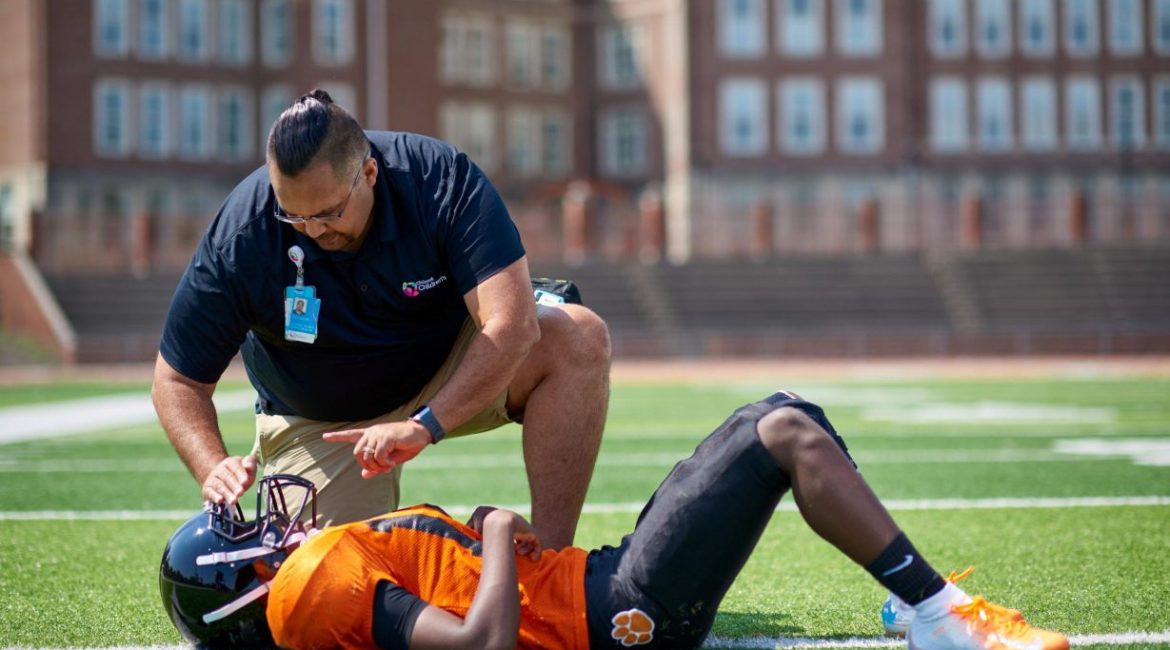
How Did Tyler Ulrich Get Injured? What Really Happened?
A college football game on October 10, 2026, took a devastating turn when Southern Nazarene University defensive back Tyler Ulrich suffered a serious injury on the field. Five days later, the 21-year-old athlete died in the hospital, leaving his family, teammates, coaches, and football fans searching for answers.
How did Tyler Ulrich get injured? That’s the question many people have been asking since news of his death emerged. According to published reports, Ulrich suffered a head injury during Southern Nazarene’s game against Ouachita Baptist University in Arkansas. However, the exact play or physical contact that caused the injury has not been publicly established.
The game was delayed for nearly an hour while medical personnel treated Ulrich. He was subsequently taken to a hospital, where his condition remained critical.
His death on October 15 prompted tributes from the football community and raised questions about what happened during the game.
This article examines the confirmed timeline, the available medical information, Ulrich’s football career, and how his university responded. It also explains what remains unknown about the injury and why those unanswered questions matter.
How Did Tyler Ulrich Get Injured During the Football Game?
The central question surrounding Tyler Ulrich’s death is also the one that remains the hardest to answer completely.
On Saturday, October 10, 2026, Ulrich was playing for Southern Nazarene University against Ouachita Baptist University. The game took place in Arkadelphia, Arkansas, and ended in a 49–14 victory for Ouachita Baptist.
During the contest, Ulrich suffered a serious injury that required emergency medical attention on the field. Reporting from CBS Sports, the Associated Press, and local news outlets confirms that the game was delayed for nearly an hour while medical personnel responded.
What exactly happened on the field?
The available reports do not identify a specific tackle, helmet collision, or other physical incident as the confirmed cause.
This distinction matters.
In football, injuries can happen during a tackle, a block, a fall, or other contact. But none of those possible mechanisms should be presented as the explanation for Ulrich’s injury without supporting evidence.
NBC Sports reported that Southern Nazarene play-by-play announcer Dave Myrick saw Ulrich down on the field after a play but could not tell what had happened. That is an important piece of eyewitness context because it reinforces the limits of what has been publicly established.
Was Tyler Ulrich’s injury a head injury?
According to reporting by KFOR, Tyler’s father, Mark Ulrich, referred to a head injury when announcing his son’s death.
Southern Nazarene University used the broader description of a traumatic injury in its public communications.
Neither statement establishes a specific medical diagnosis. Public reports have not confirmed whether Ulrich suffered a concussion, intracranial bleeding, or another particular type of brain injury.
Why was the game delayed?
Medical personnel attended to Ulrich on the field before he was transported to a hospital.
The interruption reportedly lasted around 45 minutes to nearly an hour, a substantial delay during a college football game.
The length of that stoppage shows that a significant medical response occurred, but it does not independently establish his diagnosis or the treatment he received.
The essential answer is that Tyler Ulrich suffered a reported head injury during the October 10 game, but precisely how that injury occurred remains unconfirmed.
That is the most accurate explanation supported by the reporting available as of October 18.
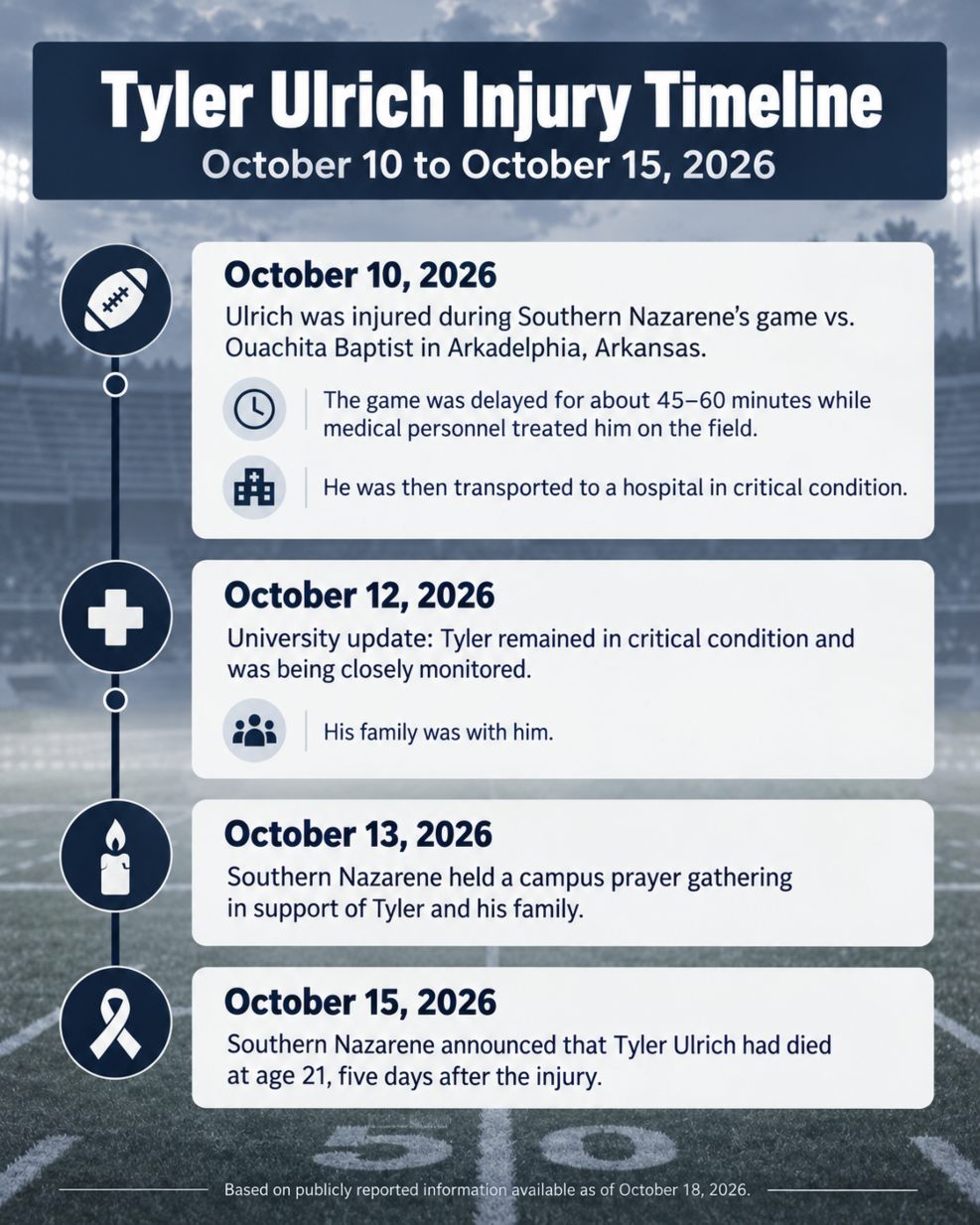
Tyler Ulrich Injury Timeline: October 10 to October 15
Understanding what happened over those five days helps separate the confirmed events from the questions that have not yet been answered.
What happened immediately after the injury?
On October 10, medical personnel responded to Ulrich during the game. He was then transported to a hospital.
The public record does not provide a detailed, minute-by-minute account of his treatment. There is no verified public information establishing the exact procedures performed on the field or after he reached the hospital.
For readers following the story, that is an important limitation. A serious injury requiring hospitalization may prompt speculation, but the medical response cannot be reconstructed accurately without reliable records or statements.
What was his condition in the hospital?
By Monday, October 12, the university had confirmed that Ulrich remained critically ill.
Tollya Spindle, Southern Nazarene’s executive director of administration and communications, told The Oklahoman that his condition was being monitored closely and that his family was with him.
The school also remained in contact with his family through coaches and athletic administrators.
When did Tyler Ulrich pass away?
Tyler died on Thursday, October 15, 2026, at the age of 21.
Local station KFOR reported that his father identified 11:13 a.m. as the time of death.
Southern Nazarene President Keith Newman announced the loss to the university community and acknowledged the support surrounding Tyler throughout his hospitalization.
The five-day period between the injury and his death is a confirmed part of this story. It should not, however, be used to speculate about his medical treatment, prognosis, or what doctors may have expected.
No public timeline can capture what those days were like for his family. The confirmed reporting establishes that he remained in hospital, surrounded by people who cared about him, until his death.
What Was Tyler Ulrich’s Cause of Death?
Although reports have identified a head injury during the football game, an official medical cause of death has not been publicly released in the reporting reviewed for this article.
This is one of the most important details for anyone searching for the Tyler Ulrich injury story.
The Associated Press reported that Southern Nazarene confirmed his death but did not reveal the nature of the injury or the cause of death.
His father’s description provides further context about the location of the injury, but it does not replace a formal medical finding.
What is the difference between a head injury and a concussion?
A head injury describes damage or trauma involving the head. A concussion is a type of traumatic brain injury that can follow a blow or jolt affecting the brain.
Not every head injury is a concussion, and not every serious brain injury has the same symptoms or medical consequences.
According to the Centers for Disease Control and Prevention (CDC), concussion symptoms may appear immediately or develop over time.
The CDC also warns that some symptoms can indicate a more serious brain injury requiring emergency care.
Could a head injury become life-threatening?
Yes. Serious traumatic brain injuries can be life-threatening, depending on their nature and severity.
However, explaining that medical possibility is not the same as determining what happened to a specific person.
For Tyler Ulrich, the available information does not establish the precise medical process that led to his death.
It would therefore be inaccurate to assert that a particular type of brain injury, bleed, or neurological complication caused his death.
What medical details are still missing?
Several questions remain unanswered publicly:
– What exact physical contact or movement caused the injury?
– What was the formal medical diagnosis?
– Were additional injuries identified?
– What was the certified medical cause of death?
– Will the university or family release further details?
These are reasonable questions, but not every medical detail must become public.
Families have a legitimate interest in medical privacy, especially following a sudden death. The absence of a publicly released diagnosis should not be treated as evidence of wrongdoing or a cover-up.
For readers, the useful distinction is between an injury reported by a family member, the university’s broader statement, and a medical conclusion that has not been disclosed.
Until reliable new information emerges, that is where the explanation must stop.
Who Was Tyler Ulrich? His Football Career and Background
Tyler Ulrich was more than the subject of a tragic college football news story.
He was a 21-year-old student-athlete from Azle, Texas, who played defensive back, primarily safety, for Southern Nazarene University in Bethany, Oklahoma.
He previously attended Azle High School, where he developed as a football player before joining Southern Nazarene’s NCAA Division II program.
Tyler Ulrich’s Southern Nazarene football career
According to Associated Press reporting, Ulrich was in his third season with the Crimson Storm.
Across his college career, he had appeared in 20 games and started 16, including six starts during the 2026 season.
The AP also reported that he ranked third on the team with 36 tackles at the time of his death.
These figures show that he was an established contributor to Southern Nazarene’s defense rather than an inexperienced newcomer.
Different news reports have cited different tackle totals. For consistency, this article uses the 36-tackle figure reported by the Associated Press rather than combining potentially different statistical cutoffs.
What position did Tyler Ulrich play?
Ulrich played safety, a defensive position responsible for helping protect against passing plays and stopping opposing ball carriers.
Safeties must read offensive movements, track receivers, and make tackles in open space.
The role demands speed, physical strength, awareness, and quick decisions.
It is also a position where players regularly experience contact, but the demands of his role do not explain the specific injury he suffered on October 10.
What did coaches say about him?
Following his death, Southern Nazarene head coach Dustin Hada remembered Ulrich for his faith, loyalty, positive spirit, and strength of character.
Former Azle High School coach Jason Vines also spoke warmly about Ulrich in local reporting, emphasizing the kind of person he was away from competition.
These tributes provide a more complete picture of Tyler than his playing statistics alone.
They show how he was remembered by people who knew him before and during his college football career.
And while his football career drew public attention to his death, those personal relationships explain why the loss was felt so deeply in both Texas and Oklahoma.
How Southern Nazarene University Responded to Tyler Ulrich’s Death
Southern Nazarene University’s response began while Tyler was still in the hospital and continued after his death was announced.
The university, based in Bethany, Oklahoma, faced the loss of a member of its football program during the middle of the season.
Its public statements focused on Tyler’s family, his teammates, and the wider campus community.
What did Southern Nazarene say?
On October 15, Southern Nazarene Athletics confirmed that Tyler had died and publicly expressed sympathy for his loved ones.
University President Keith Newman also issued a statement acknowledging Tyler’s hospitalization and the support shown by family members, teammates, and friends.
The statements recognized that this was not only a loss for the football team, but also for the wider university community.
Why did Southern Nazarene cancel its next football game?
The university canceled its game against Southwestern Oklahoma State, scheduled for Saturday, October 17.
The decision was announced following Ulrich’s death and allowed the program to respond to the loss without immediately returning to competition.
There is no need to speculate about internal discussions behind that decision. Its practical effect was that the team did not have to play its next scheduled game during the immediate period of mourning.
CBS Sports and the Associated Press both confirmed the cancellation.
What support was offered to students and teammates?
Before Tyler’s death, Southern Nazarene held a campuswide prayer gathering in his honor.
Following the announcement, university officials reminded students, faculty, and staff that support was available through the Renew Counseling Center and campus pastors.
This response reflected the university’s religious identity while also providing counseling resources for people affected by the loss.
How did Tyler Ulrich’s family and hometown respond?
Tyler’s father, Mark Ulrich, publicly confirmed his son’s death and expressed gratitude for the support the family had received.
News outlets also reported tributes from people connected to Tyler’s hometown of Azle, Texas, including his former high school coach.
Community fundraising efforts were established to help the family.
The reaction across multiple communities is one of the defining aspects of this story.
For teammates, losing Tyler meant losing someone who had trained and competed alongside them. For former coaches, it meant the death of a young man they had watched grow. For his family, the loss was far more personal than any headline can express.
Those perspectives deserve a place alongside the factual account of the injury.
What Tyler Ulrich’s Injury Tells Us About Football Safety
Tyler Ulrich’s death has renewed attention to a question that extends beyond one university: how should college football programs prepare for serious injuries?
It is important to make one distinction before examining that issue.
There is no verified evidence in the reporting reviewed here that Southern Nazarene violated medical protocols or that a specific safety failure caused Ulrich’s injury.
A discussion about football safety can be useful without implying that the university or its medical staff acted improperly.
Why are head injuries a concern in football?
Football is a contact sport in which players regularly experience hits and sudden changes in movement.
Some impacts can cause concussions or other traumatic injuries.
The CDC explains that a concussion may follow a blow to the head or a forceful impact to the body that causes the head and brain to move rapidly.
Symptoms can include headache, confusion, dizziness, and difficulty concentrating. More serious warning signs can indicate a medical emergency.
But that general medical explanation should not be used as a substitute for Tyler Ulrich’s missing diagnosis.
What are the warning signs of a serious head injury?
The CDC identifies several symptoms that require urgent emergency evaluation following a head injury.
These include worsening headaches, repeated vomiting, seizures, unusual confusion, weakness, slurred speech, difficulty remaining awake, and unequal pupil size.
Some symptoms may not appear immediately, which is why proper medical assessment and monitoring matter.
If a player is suspected of having a concussion, CDC guidance recommends removing that athlete from play and preventing a same-day return until appropriate medical clearance requirements are met.
What does the NCAA require for concussion safety?
The NCAA requires member schools to maintain concussion management plans consistent with its Concussion Safety Protocol Checklist.
Those plans address medical assessment, removal from competition, and safe return-to-play decisions.
The NCAA updated its concussion safety guidance in 2026, with changes effective July 1.
The organization also emphasizes medical decision-making by qualified healthcare professionals rather than leaving return-to-play decisions solely to coaches or athletes.
Why emergency preparation matters
Every football program must be prepared to respond when an athlete needs urgent medical care.
Preparation includes clearly defined responsibilities, access to appropriately trained personnel, and plans for emergency transport and communication.
The NCAA’s broader safety resources address the prevention of catastrophic injury and death in collegiate athletics.
These precautions cannot guarantee that every injury will be prevented. They are intended to improve how programs recognize and respond to dangerous situations.
Tyler’s story is a reminder of why that preparation matters, even though his case cannot be used to judge compliance without more evidence.
What questions should football programs continue to ask?
Programs can learn from established safety principles by reviewing how quickly injuries are recognized, how medical professionals communicate, and how players and families receive support.
They can also examine whether staff members understand emergency plans and whether those plans are practiced regularly.
This is an area where the conversation should remain practical.
The objective is not to assign blame without facts. It is to keep athlete safety central to the sport.
For readers trying to understand Tyler Ulrich’s injury, the most useful lesson is the importance of reliable reporting, appropriate emergency medical care, and respecting the limits of what is publicly known.
What Remains Unknown About Tyler Ulrich’s Final Game?
Even after extensive media coverage, several important questions about Tyler Ulrich’s injury remain unanswered.
The most significant is the exact incident that caused him to become injured during the October 10 game.
Reporting has established that he received medical attention and was hospitalized, but published accounts do not provide a conclusive description of the play.
Is there a verified video of Tyler Ulrich’s injury?
The reporting reviewed for this article does not establish the existence of a publicly verified video showing the exact moment of injury.
Readers should be cautious about clips shared on social media without a clear source, date, or connection to the game.
A video of the matchup is not necessarily proof that the injury itself was captured.
Has an official investigation been announced?
The authoritative reporting reviewed for this article does not confirm a formal investigation into the incident.
That does not establish whether any internal review has occurred. It simply means no verified public findings were available in the sources examined.
Could more information be released?
Further details could become available through family statements, university announcements, official medical findings, or reliable reporting.
However, no publication date for additional information has been established.
The important distinction is between new evidence and renewed speculation. Repeating an unverified explanation across several websites does not turn it into a confirmed fact.
As of October 18, 2026, the most defensible conclusion remains that Tyler Ulrich sustained a serious injury during the game, his father identified a head injury, and he died five days later.
The precise mechanism and official medical cause of death remain undisclosed.
Remembering Tyler Ulrich Beyond the Injury
The question “How did Tyler Ulrich get injured?” has brought attention to a heartbreaking story in college football.
What is known is that the 21-year-old Southern Nazarene University safety suffered a serious injury during an October 10, 2026, game against Ouachita Baptist University in Arkansas.
Medical personnel treated him on the field before he was transported to a hospital. He remained hospitalized in critical condition and died on October 15.
His father described the incident as a head injury. However, the exact physical cause, detailed diagnosis, and official cause of death have not been publicly confirmed.
Those missing details are important. Readers deserve accurate reporting rather than speculation presented as certainty.
But Tyler Ulrich’s story is about much more than the unanswered questions surrounding his final football game.
He was a young athlete from Azle, Texas, who had earned a place in Southern Nazarene’s defensive lineup. He was remembered by his coaches for his character, his faith, and his commitment to the team.
His death affected people across his hometown, his university, and the wider football community.
As football fans continue following the story, the best way to honor Tyler is to share verified information, respect his family’s privacy, and remember the person behind the headlines.
His life and the relationships he built deserve to be remembered alongside the circumstances of his death.
FAQ
How did Tyler Ulrich get injured?
Tyler Ulrich suffered a reported head injury during Southern Nazarene University’s football game against Ouachita Baptist on October 10, 2026. The exact tackle, collision, or other event that caused the injury has not been publicly established.
What was Tyler Ulrich's cause of death?
Tyler died on October 15, 2026, five days after the injury. Although his father identified a head injury, an official medical cause of death has not been publicly disclosed in the reporting reviewed.
How old was Tyler Ulrich when he died?
Tyler Ulrich was 21 years old. He was a sophomore defensive back at Southern Nazarene University and was originally from Azle, Texas.
What happened to Tyler Ulrich during the Ouachita Baptist game?
Ulrich suffered a serious on-field injury during the October 10 matchup. Medical personnel treated him while the game was delayed for nearly an hour. He was then transported to a hospital.
Did Southern Nazarene cancel a game after Tyler Ulrich's death?
Yes. Southern Nazarene canceled its scheduled October 17, 2026, game against Southwestern Oklahoma State following Ulrich’s death.
Tyler Ulrich’s death has deeply affected the Southern Nazarene community and college football fans.
As more details emerge, it’s important to focus on confirmed information and remember Tyler for the person and teammate he was.
What do you think college football programs can do to further improve player safety?
Share your thoughts respectfully in the comments. If this article helped you better understand what happened, consider sharing it with other football fans.

Teams That Have Never Won a Super Bowl (2026 Guide)
Which team will finally break the curse? Full list of teams that have never won a Super Bowl + predictions.

Wealthiest Owners in Sports: Billionaires Behind Teams
Meet the wealthiest owners in sports, from NBA tech billionaires to NFL retail dynasties. See who tops the list and how much they’re worth.
Roll Tide Meaning (Alabama Fans Guide) — What Roll Tide Really Means
What does “Roll Tide” really mean? The history, the pride, and why Alabama fans say it everywhere—not just on game day.
Biggest Blowout in NFL History (73–0 Shock)
The biggest blowout in NFL history wasn’t 59–0. It was worse. See how a 73–0 championship game still shocks fans 80+ years later.

CFL American Teams: The 1990s U.S. Expansion Story
A U.S. team once won the Grey Cup. Relive the full CFL American teams era — the cities, the drama, and why the experiment collapsed.

Steelers Super Bowl Wins: A Complete History of Pittsburgh’s Championship Glory
How many Super Bowls have the Steelers really won? Relive all 6 titles, the 1970s dynasty, and the toe-tap catch that changed history.

Greatest NFL Defenses of All Time — A Deep Dive
The greatest NFL defenses of all time — ranked by dominance, points allowed, turnovers, and playoff impact.

Green Bay Packers Quarterback History: From Starr to Rodgers and Beyond
Packers QBs tell an NFL story like no other. Relive the eras of Starr, Favre, Rodgers, and Jordan Love in this deep dive into Packers history.

Do College Football Players Get Paid? The Truth Behind Modern College Sports
Before the NFL paycheck comes college money. Do college football players get paid? Here’s how today’s stars cash in early.