

What Is the Highest Score in Snooker? Inside the Famous Snooker 147
For snooker fans, the 147 maximum break isn’t just a number — it’s snooker’s holy grail. Hit it in competition and you’ve done what every pro dreams of: potting 15 reds with 15 blacks and then all six colours in sequence for the highest normal play score in snooker. That perfect run of shots totals 147 points, the iconic ceiling most players chase but only a handful achieve.
But the story doesn’t end there. There are rare situations where players can score higher than 147 in a frame thanks to special rule scenarios. And over snooker’s long history, some unbelievable feats — from the very first 147 in 1955 to players compiling multiple maximums in a single session — have cemented the 147’s place as one of the sport’s most revered accomplishments.
In this article, we’ll break down what exactly the highest score in snooker is, how a 147 is achieved, its historical milestones, rare exceptions above 147, and the legends who’ve mastered the perfect break. Whether you’re a long-time fan or new to snooker, this guide will take you deep inside snooker’s most famous number.
Understanding the Maximum Break — What Makes 147 So Special
In snooker, the “break” refers to the total points a player scores in a single run at the table. The maximum break under normal circumstances is 147 points — potting each of the 15 red balls, always followed by a black, and then clearing all six colours.
How the 147 Score Adds Up
Here’s the breakdown:
– 15 reds x 1 point = 15
– 15 blacks x 7 points = 105
– 6 colours (yellow, green, brown, blue, pink, black) = 27
– Total = 147
That sequence — red, black, red, black … to colours — is the most efficient way to score every point available in a normal frame. The black ball has the highest value among the colours, so clearing reds with blacks maximizes points.
Potting 36 balls without missing once requires incredible precision, intense focus, and perfect cue ball control, which is why a 147 is one of the rarest accomplishments in sport.
A Brief History: From Joe Davis to Modern Masters
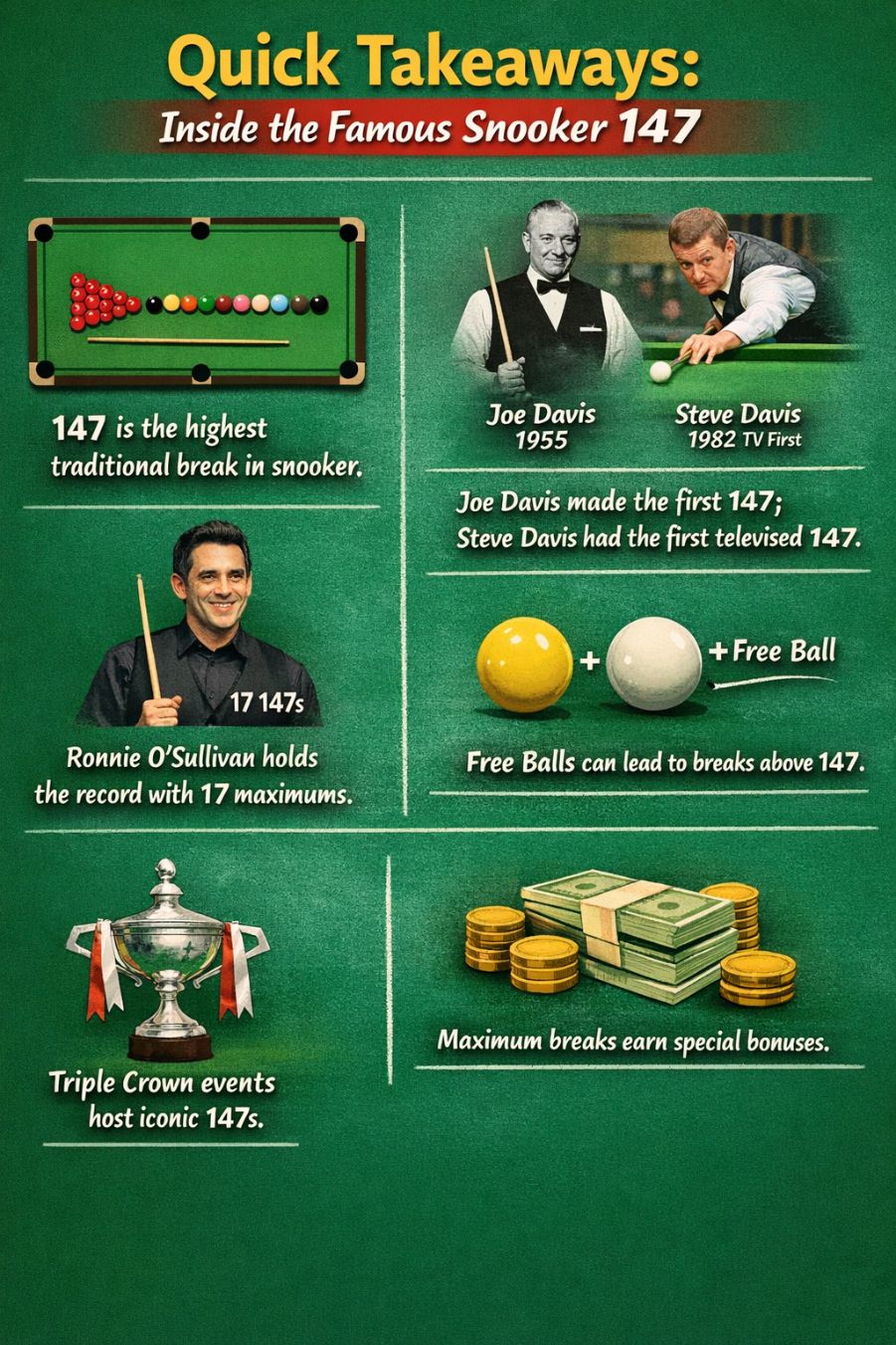
The first officially recognized 147 break was made by Joe Davis in 1955 during an exhibition match in London. Davis, already a 14-time world champion by then, set the standard for excellence in the sport with that perfect break.
The very first televised maximum came decades later, in 1982, when Steve Davis hit one during the Lada Classic. That moment helped show the wider world just how special a 147 really is, bringing it into living rooms and onto highlight reels.
Since then, the number of official 147s has steadily grown as players have become more skilled and competitive formats have expanded. Still, even today, a maximum break remains special and memorable when it happens.
Record Breaks Above 147 — How Is That Even Possible?
Under standard rules, 147 is the highest normal break in snooker. But the game has a special rule called a free ball that sometimes allows breaks above 147 — up to a theoretical maximum of 155 points.
Here’s how that can happen:
– A player’s opponent fouls and leaves them snookered on all reds.
– The player gets a free ball, meaning they can nominate a colour as an extra “red.”
– If that free ball is potted and treated as a red followed by a black (and then all 15 real reds with blacks and all colours), the point total can exceed 147.
This has only rarely occurred in professional settings. The most famous instance is Jamie Burnett’s 148 break during qualifying for the 2004 UK Championship, when a free ball situation produced an extra scoring opportunity.
Breaks of 155 — the absolute theoretical maximum — have been recorded in practice frames and on video, but not in major televised professional competition. When free balls align and are played perfectly, a 155 becomes possible.
So while 147 remains the highest “standard” score, snooker’s rules make those rare exceptions above it possible — giving even experienced fans something to debate.
All-Time Greats Who’ve Mastered the Maximum
Over snooker’s modern era, a handful of elite players have become synonymous with the 147 break. Let’s look at some of the most remarkable names:
Ronnie O’Sullivan — The Maximum Magnet
Ronnie O’Sullivan stands alone at the top when it comes to maximum breaks in professional competition. As of 2025, he’s compiled 17 competitive 147s — more than any other player in history.
In August 2025 at the Saudi Arabia Snooker Masters, he made history by scoring two maximums in a single session and became the oldest player ever to record a 147 in professional competition at age 49 years, 253 days.
O’Sullivan’s first Crucible maximum in 1997 was also remarkable for its blazing speed — he completed the 147 in just over five minutes, a record that still stands among the fastest seen.
Stephen Hendry — The Early Dominator
Stephen Hendry was a dominant force in the 1990s and left an indelible mark on 147 history. He compiled numerous maximum breaks in major events and was known for his clinical break-building. Jeff Hendry also shares a record with O’Sullivan for the most Crucible 147s made at the World Championship.
John Higgins and Shaun Murphy — The Modern Masters
John Higgins has been a consistent performer and among the top maximum break makers of the last two decades, frequently turning heads with his tactical genius.
Shaun Murphy, another top professional, hit his 10th career 147 in 2025 — joining an elite group of players with double-digit maximums.
These names and others — including Mark Selby, Mark Allen, and Neil Robertson — have all made memorable contributions to snooker’s maximum break lore on the sport’s biggest stages.
Maximum Breaks at Major Tournaments
Some stages make maximums even sweeter:
World Championship Breaks
The World Snooker Championship at Sheffield’s Crucible Theatre has seen numerous iconic 147s. The first came from Cliff Thorburn in 1983, and since then, players like Jimmy White, Stephen Hendry, Ronnie O’Sullivan, Mark Selby, and Mark Allen have all hit maximums at snooker’s most prestigious event.
Each maximum at the Crucible carries extra weight, given the pressure and status of that tournament.
The Masters
The elite invitational Masters tournament has been the scene of several memorable 147s as well. As of late 2025, there have been six maximum breaks at The Masters, with the latest by Shaun Murphy.
Triple Crown events like the Masters, UK Championship, and World Championship are where 147s truly become part of snooker lore.
The Psychology Behind the 147
Making a maximum isn’t just about potting balls — it’s a mental discipline. You have to:
– Plan each shot well in advance to keep position for the next pot.
– Stay calm under pressure, especially when the crowd knows you’re on the brink of a historic break.
– Manage nerves, because one tiny miscuing moment can derail the entire run.
Like a golfer lining up a final putt or a darts player on a nine-dart finish, the mental resilience required is intense.
Prize Money and Prestige of a 147
In many professional tournaments, there’s a bonus for a maximum break — sometimes a shared prize fund specific to 147s. At some Triple Crown events, hitting multiple maximums in a season can trigger special prize structures.
In qualifying events, players have earned significant bonuses for unique achievements such as two 147s in one match. For example, Jackson Page earned a £147,000 bonus for his historic double maximum in 2025.
Can the Maximum Ever Be Broken?
In terms of standard break scoring, 147 is generally considered the highest possible. Yet snooker’s rules make room for odd situations that allow breaks above that figure.
Even so, those unusual breaks — like a rare 148 in professional competition — are exceptional. In most contexts, snooker players and fans treat 147 as the true maximum — the ultimate mark of break-building excellence.
Conclusion — The Legacy of the 147 in Snooker
For decades, the 147 maximum break has stood as snooker’s defining achievement — a blend of precision, calm under pressure, and technical mastery. While rare exceptions above 147 exist in specific rule scenarios, the classic 147 remains the standard that players aspire to, fans celebrate, and commentators recount with reverence.
From Joe Davis’s first officially recognized maximum in 1955 to Ronnie O’Sullivan’s record-breaking runs in 2025, every generation has added its chapter to the story of the 147. It’s a number that instantly tells fans they’ve just witnessed something special — a moment where skill, focus, and history aligned on the green baize.
If you’ve ever wondered what makes snooker such a unique sport, understanding the 147 — and why it still matters — takes you right to the heart of the game.
FAQs
What is the highest score in snooker?
The highest regular break under normal rules is 147, known as a maximum break.
How do you score a 147 maximum break?
By potting all 15 reds each followed by a black, and then clearing the six colours.
Has anyone scored more than 147?
Yes — breaks above 147 (like 148) have happened in rare situations involving a free ball, but not as a standard competitive maximum.
Who holds the record for most 147s?
Ronnie O’Sullivan holds the most competitive 147s with 17.
Why is the 147 break so celebrated?
Because it represents near-perfect play throughout an entire frame and is difficult to achieve under competitive pressure.