
Who Is Kimi Antonelli? Age, Career, Net Worth and F1 Journey
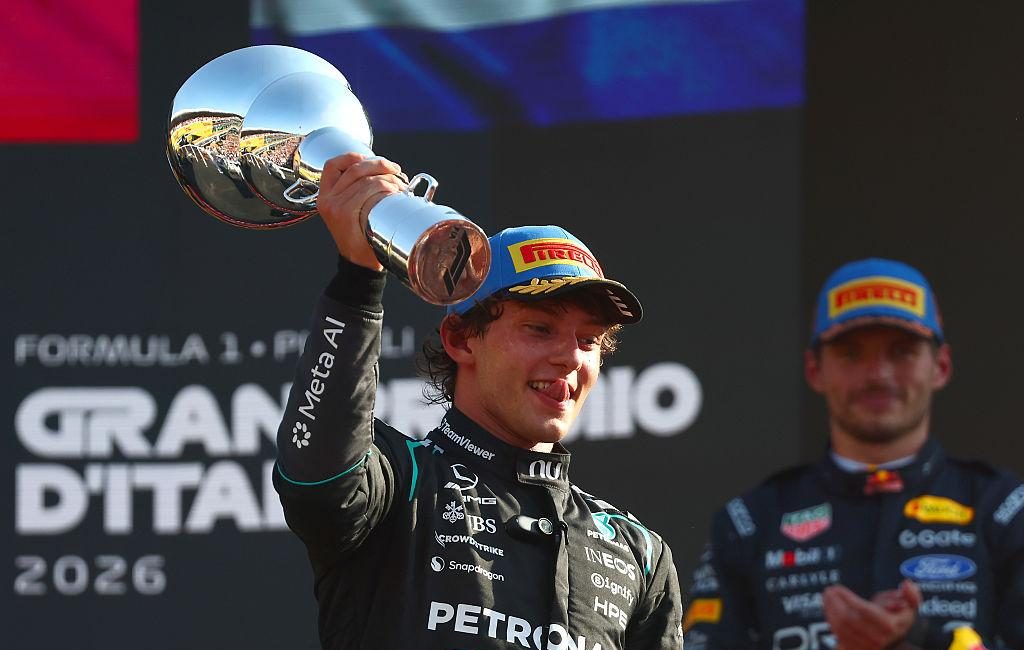
At just 20 years old, Kimi Antonelli has already achieved something many racing drivers spend their entire careers chasing: winning Formula 1 races and leading the World Drivers’ Championship.
But his journey to the top didn’t happen overnight.
Born in Bologna, Italy, Antonelli started racing go-karts when he was seven. He quickly became one of Europe’s most promising young drivers, winning championships in karting, Formula 4, and Formula Regional before making an unusual jump directly into Formula 2.
Mercedes recognized his potential early. The team brought him into its junior programme in 2019 and eventually selected him to replace seven-time world champion Lewis Hamilton in 2025.
Since then, the Kimi Antonelli F1 career has progressed rapidly. His rookie season delivered podium finishes and several records, while his performances in 2026 have made him a serious contender for the world championship.
So, who is Kimi Antonelli, and how did he reach Formula 1 so quickly?
This article covers his childhood, racing achievements, Mercedes journey, reported earnings, championship results, and what his future could look like.
Who Is Kimi Antonelli? Age, Nationality and Background
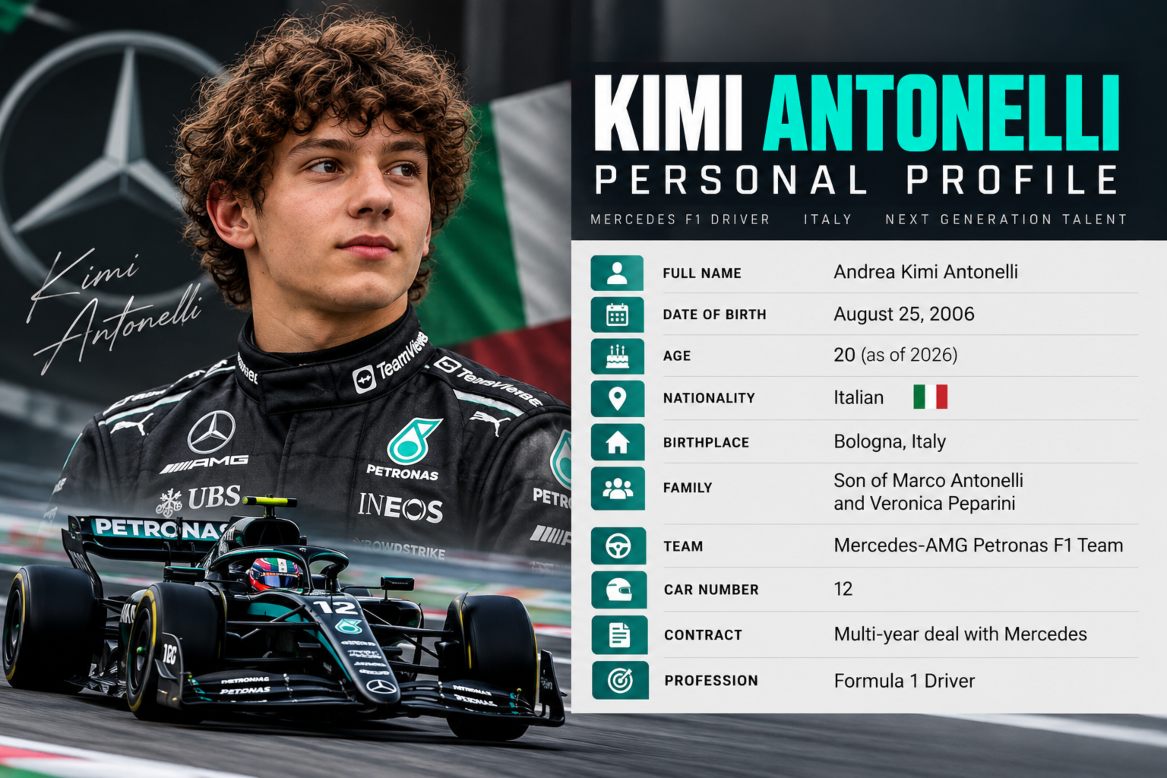
Andrea Kimi Antonelli is an Italian professional racing driver competing in Formula 1 for Mercedes-AMG Petronas.
He was born on August 25, 2006, in Bologna, Italy, and grew up surrounded by motorsport.
At 20, he is among the youngest drivers in Formula 1, yet he already has multiple race victories and experience competing at the front of the championship.
His rapid development has attracted attention from fans who want to know more about his background, family, and personal life.
Growing up in a motorsport family
Racing was part of Antonelli’s childhood long before he entered Formula 1.
His father, Marco Antonelli, competed in motorsport and established a racing operation of his own.
That gave young Kimi an opportunity to understand the sport from an early age.
He spent time around racing cars, mechanics, engineers, and drivers, gaining experience with an environment most children only see on television.
However, having family connections in motorsport doesn’t guarantee success.
Drivers still have to demonstrate speed, consistency, and the ability to improve as competition becomes stronger.
Antonelli began showing those qualities in karting.
Why is his name Kimi?
Many fans assume Antonelli was named after Finnish Formula 1 world champion Kimi Räikkönen.
The connection seems logical, especially given their shared involvement in motorsport.
However, Mercedes has explained that his name wasn’t chosen as a tribute to Räikkönen.
Kimi is Antonelli’s middle name, suggested by a family friend who thought it sounded good alongside Andrea Antonelli.
How his upbringing influenced his development
Having access to racing knowledge at a young age helped Antonelli understand that professional motorsport involves more than driving quickly.
Drivers must communicate with engineers, respond to pressure, understand vehicle setup, and work as part of a team.
These skills become increasingly important at higher levels.
Antonelli’s upbringing gave him early exposure to that environment, while his junior racing results eventually proved he had the ability to compete professionally.
His development also attracted Mercedes’ attention when he was still a child.
By joining the team’s junior programme at 12, he gained access to structured support that would help shape his future in Formula 1.
How Kimi Antonelli Started His Racing Career
Antonelli’s motorsport journey began in karting when he was seven.
Karting is where many Formula 1 drivers develop their earliest racing skills.
Although go-karts are much smaller than Formula 1 cars, competitive karting requires precise steering, strong braking technique, and an understanding of racing lines.
It also teaches young drivers how to overtake, defend positions, and handle pressure.
Early karting success
Antonelli quickly established himself as a competitive young driver.
He won his first major karting titles in 2015 while competing in the EasyKart 60 category.
Over the following years, he progressed into more competitive international championships.
His results included victories in several European competitions, including the WSK Euro Series and WSK Super Master Series.
However, his biggest karting achievements came when he won consecutive European championships.
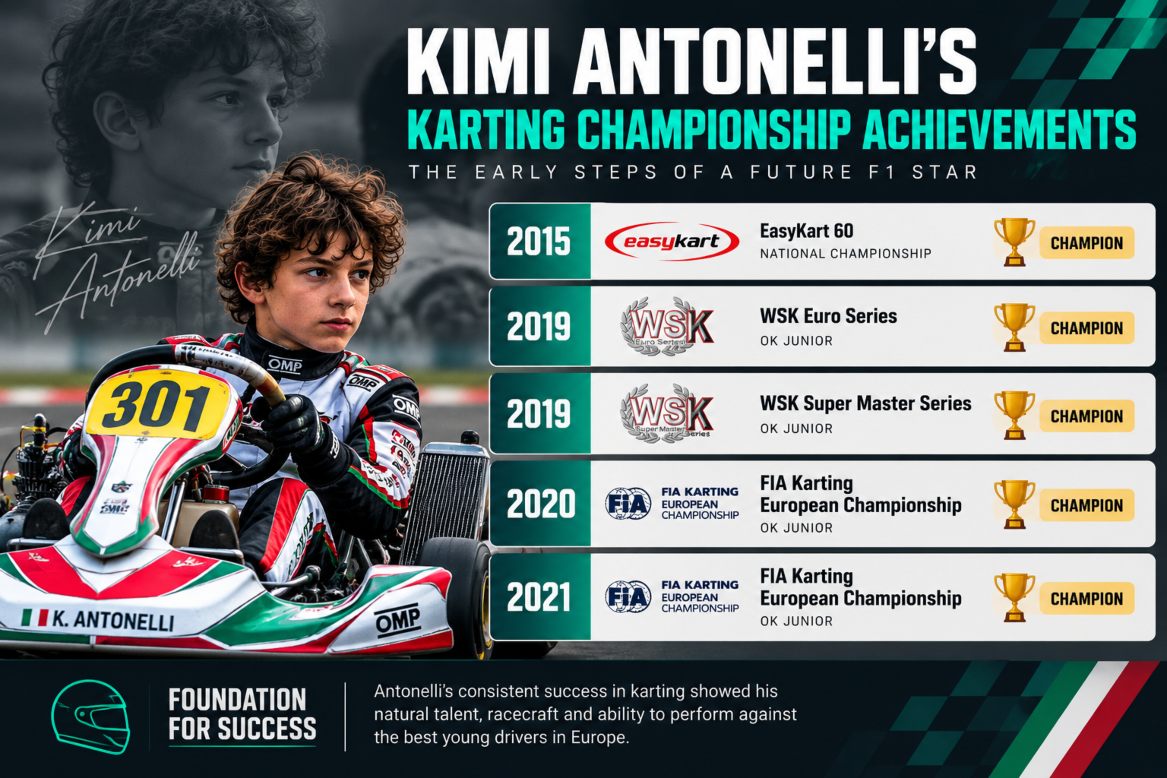
Winning back-to-back European championships was particularly significant.
It demonstrated that Antonelli could perform consistently against talented competitors across different circuits and racing conditions.
His results made him one of the most closely watched young drivers in European motorsport.
Joining the Mercedes Junior Programme
Mercedes signed Antonelli to its Junior Programme in April 2019.
He was just 12 years old.
The programme identifies young racing talent and supports drivers as they progress toward professional competition.
For Antonelli, Mercedes’ involvement provided access to experienced racing professionals, coaching, physical preparation, and structured career development.
It also meant the team could monitor his progress long before he became eligible to compete in Formula 1.
Why Mercedes invested in him so early
Junior driver programmes involve considerable long-term uncertainty.
A successful young karting driver won’t necessarily become a competitive Formula 1 racer.
The transition involves multiple racing categories, more complex cars, stronger competition, and significant financial commitments.
Mercedes nevertheless believed Antonelli had exceptional potential.
His karting results demonstrated speed, while his ability to adapt across different events suggested he could handle more demanding championships.
That early relationship became important when Mercedes eventually needed a new Formula 1 driver.
Rather than judging Antonelli from one season of junior racing, the team had several years of development data.
That gave Mercedes a stronger basis for understanding his abilities and deciding when he was ready for Formula 1.
Kimi Antonelli’s Journey From Formula 4 to Formula 2
Moving from karting into single-seater racing is one of the biggest challenges in a young driver’s development.
The cars are heavier and more powerful, aerodynamics become important, and racing strategy becomes increasingly complex.
Antonelli adapted quickly.
His progression through the junior categories was so rapid that he skipped Formula 3 entirely.
Formula 4 success in 2022
Antonelli began competing in Italian Formula 4 during 2021.
The following season, he raced in both the Italian F4 Championship and ADAC Formula 4 Championship.
He won both titles.
Across those championships, Mercedes credits him with 22 victories, 21 pole positions, and 27 podium finishes.
Those results demonstrated more than consistency.
They showed that Antonelli could qualify at the front, maintain competitive race pace, and regularly convert strong starting positions into victories.
For a young driver attempting to progress toward Formula 1, those are important skills.
Dominating Formula Regional in 2023
Antonelli moved into Formula Regional racing in 2023.
He won the Formula Regional Middle East Championship and Formula Regional European Championship by Alpine.
His success in Europe included five victories against other promising young drivers.
By the end of the season, Antonelli had secured four major junior single-seater titles across two years.
The results strengthened Mercedes’ belief that he was ready for a more demanding challenge.
Why did Antonelli skip Formula 3?
Most young drivers follow a familiar path through junior motorsport.
They progress from Formula 4 to Formula Regional, Formula 3, Formula 2, and finally Formula 1.
Antonelli took a different route.
Mercedes supported his move directly from Formula Regional to Formula 2 in 2024.
The decision accelerated his development, but it also increased the difficulty of his next season.
Formula 2 cars require greater technical understanding, particularly when managing tires, braking performance, and race strategy.
His Formula 2 season with PREMA
Antonelli joined PREMA Racing for the 2024 championship.
His campaign began with several difficult races as the team worked to understand the new Formula 2 car.
However, his performances improved.
He won the Sprint Race at Silverstone in challenging wet conditions.
He then secured a Feature Race victory in Hungary.
Antonelli finished sixth in the championship standings.
Although he didn’t win the title, his two victories helped demonstrate that he could compete against more experienced drivers.
What his rapid progress tells us
The most interesting part of Antonelli’s junior career is that Mercedes didn’t require him to win every championship before advancing.
Instead, the team appeared to place significant value on his ability to adapt quickly.
His results suggest that he could learn new machinery and remain competitive without spending several seasons in each category.
That made him an unusual prospect.
It also explains why Mercedes was willing to offer him a Formula 1 seat after just one Formula 2 season.
For readers studying the kimi antonelli formula 2 career, the key point is that sixth place doesn’t fully explain why Mercedes promoted him. His wider racing history and long-term development were equally important.
How Kimi Antonelli Joined Mercedes F1
Antonelli’s opportunity to join Formula 1 became much more realistic when Lewis Hamilton announced that he would leave Mercedes for Ferrari at the end of 2024.
Hamilton had played a central role in Mercedes’ success, winning six of his seven world championships with the team.
Replacing him was a major responsibility.
Mercedes could have selected an experienced driver, but team principal Toto Wolff believed Antonelli had the potential to become an important part of its future.
Kimi Antonelli replacing Lewis Hamilton
Mercedes officially confirmed Antonelli as its 2025 driver during the Italian Grand Prix weekend in August 2024.
He would race alongside George Russell.
At that stage, Antonelli was still only 18 and competing in Formula 2.
The decision attracted considerable attention.
Some observers questioned whether he had enough experience to handle the pressure of driving for Mercedes.
Others believed his junior racing achievements justified the opportunity.
His difficult first Formula 1 practice session
Antonelli participated in his first official Formula 1 practice session at Monza in August 2024.
He was driving the Mercedes during FP1 when he lost control and crashed.
It wasn’t the ideal introduction.
The incident received significant media coverage because the team was preparing to announce him as Hamilton’s successor.
However, Mercedes maintained its confidence in him.
The team recognized that mistakes are part of a young driver’s development, particularly when learning a Formula 1 car.
Why Mercedes chose youth over experience
Mercedes’ decision reflected a long-term approach.
Instead of choosing someone who could provide immediate experience, the team selected a driver it had developed since childhood.
That gave Antonelli an opportunity to learn Formula 1 while already working within a familiar organization.
It also created considerable pressure.
Every mistake would attract attention because of the driver he had replaced.
The challenge of following Hamilton
Hamilton was one of the most successful Formula 1 drivers in history.
Antonelli wasn’t realistically expected to match his achievements immediately.
His first responsibility was to learn the championship, collect points, and develop into a driver capable of competing consistently.
However, Mercedes’ ambition meant that development would happen under intense scrutiny.
That made Antonelli’s rookie campaign an important test of both his driving ability and his mental resilience.
The team’s decision has since been supported by his performances, particularly his major improvements during 2026.
Kimi Antonelli’s 2025 F1 Rookie Season: Results and Records
Antonelli began his Formula 1 journey at the 2025 Australian Grand Prix.
He was 18 years old, making him one of the youngest drivers ever to start a World Championship race.
His rookie season included impressive achievements, difficult weekends, and valuable experience competing against established drivers.
His Formula 1 debut in Australia
Antonelli finished fourth in Melbourne.
It was a strong opening result for a driver entering Formula 1 directly from Formula 2.
The race demonstrated that he could manage a full Grand Prix weekend while competing against experienced opponents.
However, one race wasn’t enough to establish his long-term potential.
He needed to demonstrate consistency throughout the season.
Making history in Japan
At the Japanese Grand Prix, Antonelli became the youngest driver to record the fastest lap of a Formula 1 race.
That achievement highlighted his speed despite his limited experience.
It also showed that he could deliver competitive lap times against drivers who had spent several years in Formula 1.
Sprint pole position in Miami
Antonelli achieved another milestone during the Miami Grand Prix weekend.
He secured pole position for the Sprint Race, becoming the youngest driver to achieve an F1 pole of any kind.
A Sprint pole is different from a traditional Grand Prix pole, but it remains an impressive qualifying achievement.
His performance showed that he could deliver a fast lap under pressure.
First Grand Prix podium in Canada
Antonelli secured his first Formula 1 podium at the Canadian Grand Prix.
He finished third, becoming one of the youngest drivers to stand on an F1 podium.
The achievement was especially important because podium finishes require more than qualifying speed.
Drivers need to manage tires, respond to changing conditions, and maintain concentration over the entire race.
His end-of-season performance
Antonelli added further podium finishes in Brazil and Las Vegas.
Learning from George Russell
Russell provided an important reference point during Antonelli’s first year at Mercedes.
He had considerably more Formula 1 experience and understood how to manage long championship campaigns.
Antonelli could compare his qualifying performance, race pace, and technical feedback with an established teammate.
The experience helped him understand what was required to become a consistent front-running driver.
By the end of 2025, Antonelli had demonstrated genuine pace, but his performances still varied between races.
His rookie season showed that he belonged in Formula 1. His second season would determine whether he could compete for championships.
Kimi Antonelli’s 2026 F1 Season: Wins, Records and Championship Results
Antonelli’s second Formula 1 season has been considerably more successful than his first.
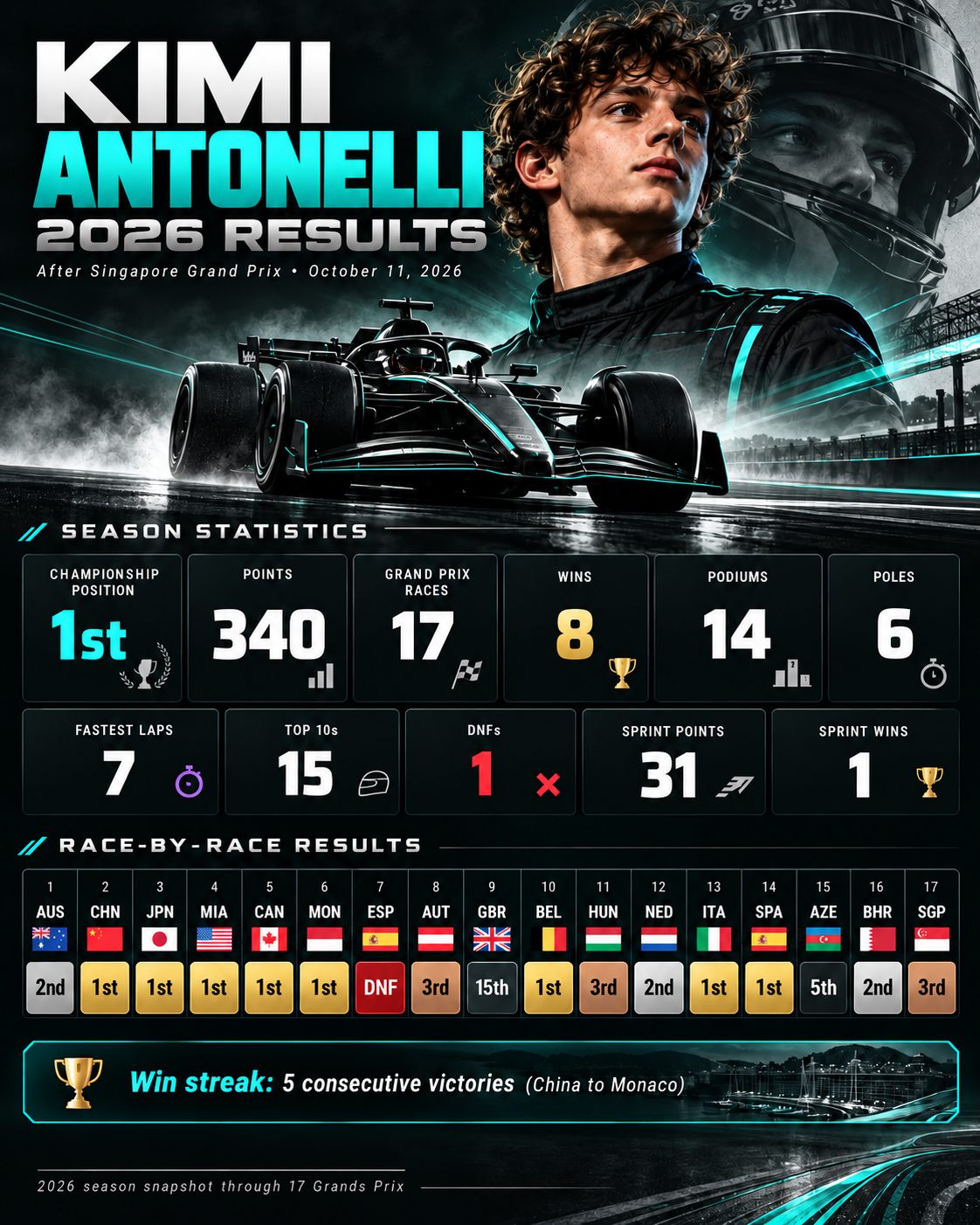
As of October 19, 2026, he leads the World Drivers’ Championship with 340 points after 17 Grands Prix.
He has recorded eight race victories, 14 podium finishes, and six Grand Prix pole positions.
Kimi Antonelli first F1 win: Chinese Grand Prix 2026
Antonelli secured his first Grand Prix victory in China on March 15, 2026.
The previous day, he became the youngest driver in Formula 1 history to take pole position for a Grand Prix.
He converted that achievement into a race victory at just 19 years old.
The result made him the second-youngest Grand Prix winner in F1 history, behind Max Verstappen.
His victory also marked the beginning of an impressive winning streak.
Five consecutive victories
Antonelli followed his Chinese Grand Prix victory with wins in Japan, Miami, Canada, and Monaco.
That gave him five consecutive Grand Prix victories.
Winning several races in a row requires more than a competitive car.
A driver must repeatedly perform in qualifying, avoid costly mistakes, and respond to different race conditions.
Antonelli’s performances demonstrated that he was becoming increasingly comfortable racing at the front.
His victory in Japan also made him the youngest championship leader in Formula 1 history.
His remarkable comeback at Monza
One of Antonelli’s most impressive performances came at the Italian Grand Prix in September.
He started from 19th after an engine-related grid penalty.
Despite the difficult starting position, he fought through the field and won his home race.
The result was particularly meaningful because Monza was also where he had crashed during his first official Formula 1 practice appearance in 2024.
Two years later, he returned to the same circuit and won.
The contrast demonstrated how much he had developed.
It also showed that Antonelli wasn’t dependent on starting near the front to deliver strong results.
Kimi Antonelli Net Worth, Salary and Endorsements
With Antonelli becoming one of Formula 1’s leading drivers, interest in his financial situation has increased.
Fans naturally want to know how much he earns from Mercedes and whether his success has translated into significant personal wealth.
However, financial information about professional racing drivers is often based on estimates rather than publicly disclosed contracts.
Celebrity Net Worth estimates Antonelli’s wealth at approximately $18 million.
The website attributes his earnings to his Mercedes contract, performance bonuses, and endorsement activity.
However, the figure should be treated with caution.
Neither Mercedes nor Antonelli has publicly provided a complete breakdown of his personal assets, investments, and financial obligations.
Without that information, an exact calculation isn’t possible.
Kimi Antonelli salary Mercedes
Celebrity Net Worth reports a Mercedes base salary of approximately $5 million.
It also claims that his earnings in 2025 reached around $12.5 million after bonuses.
These figures have not been independently confirmed through official contract disclosures.
A Formula 1 contract may include several types of compensation beyond the base salary.
Depending on the agreement, a driver can receive bonuses for victories, podium finishes, championship performance, and other achievements.
How Formula 1 drivers earn money
Most established Formula 1 drivers receive income through a combination of team contracts and commercial partnerships.
Team salaries usually represent their main earnings.
Some contracts include performance bonuses tied to sporting results.
Drivers may also generate income through personal sponsors, endorsement deals, appearances, and licensing arrangements.
However, it’s important to distinguish personal sponsorship agreements from partnerships belonging to the Formula 1 team.
A logo displayed on a driver’s racing suit doesn’t necessarily mean that the company pays the driver directly.
How success affects his earning potential
Antonelli’s results in 2026 have strengthened his position as a prominent young driver.
Winning races and leading the championship can increase a driver’s commercial appeal.
Sponsors often value international visibility, sporting success, and the ability to connect with younger audiences.
Antonelli offers all three characteristics.
His Italian nationality may also make him particularly attractive to companies seeking visibility in Italy and European markets.
Still, growing commercial appeal doesn’t automatically establish his personal net worth.
The value of sponsorship agreements, future contracts, and bonuses depends on private negotiations.
The most reliable financial conclusion is that Antonelli has substantial earning potential, while precise figures about his personal wealth remain estimates.
What Makes Kimi Antonelli Such a Competitive F1 Driver?
Antonelli’s success isn’t explained by one particular skill.
Formula 1 drivers need speed, consistency, technical understanding, and the ability to make decisions under pressure.
The strongest drivers combine those qualities while adapting to different circuits and changing conditions.
Antonelli has demonstrated significant progress in these areas during his first two seasons.
Qualifying speed
Qualifying is one of Antonelli’s most obvious strengths.
His six Grand Prix pole positions in 2026 show that he can deliver competitive laps when every fraction of a second matters.
Starting from pole position provides an advantage because the driver begins the race ahead of the competition.
However, it doesn’t guarantee victory.
Drivers must still manage tire wear, race strategy, and changing track conditions.
Antonelli’s ability to convert qualifying performance into race wins is one of the clearest signs of his development.
Race management
One of the biggest differences between junior motorsport and Formula 1 is the complexity of race management.
Drivers must understand when to push, when to protect their tires, and how to respond to changes in strategy.
This is particularly important during long races where the fastest driver doesn’t always win.
Antonelli’s results suggest that his race management has improved considerably since his debut season.
His victories in Monaco and other demanding races provide examples of his ability to maintain concentration and handle pressure.
Adapting to difficult conditions
Antonelli demonstrated his ability in changing weather conditions before reaching Formula 1.
His Formula 2 Sprint victory at Silverstone in 2024 came in wet conditions.
Wet-weather racing requires drivers to adapt braking points and racing lines as grip levels change.
It also demands confidence without taking unnecessary risks.
These skills become valuable when weather or track conditions change during a Formula 1 race.
Kimi Antonelli vs George Russell
Comparisons between Antonelli and Russell are especially interesting because both compete for Mercedes.
Russell entered 2026 with considerably more Formula 1 experience.
He understands the team’s working methods and has spent several seasons competing against established drivers.
Antonelli, meanwhile, has demonstrated exceptional development during his second year.
With 340 points compared with Russell’s 238 after Singapore, Antonelli has built a significant championship advantage.
But points don’t explain every difference between teammates.
Mechanical reliability, strategy, qualifying performance, and incidents can influence individual results.
A complete comparison requires examining the wider context.
Where Antonelli can still improve
Despite his achievements, Antonelli remains early in his Formula 1 career.
He has relatively limited experience of defending a championship lead through the final stages of a season.
His continued development will depend on maintaining consistency, reducing mistakes, and managing difficult weekends effectively.
Experience may also help him make better strategic decisions when races become unpredictable.
His 2026 performances suggest that he is learning quickly.
But becoming a consistently successful Formula 1 driver requires repeating that level of performance over several seasons.
What’s Next for Kimi Antonelli in Formula 1?
Antonelli’s future looks different today from when Mercedes announced his Formula 1 promotion in 2024.
Back then, the main question was whether he had enough experience to replace Hamilton.
Now, the discussion focuses on how many victories and championships he might achieve.
His results have established him as one of Formula 1’s most promising drivers, but there are still important challenges ahead.
Can Antonelli win the 2026 World Championship?
With a 102-point lead after Singapore, Antonelli is in a strong position.
However, winning the championship requires maintaining that advantage until the remaining races are completed.
Mechanical failures, accidents, and poor qualifying performances can change the championship picture.
A driver leading the standings must therefore balance ambition with consistency.
There may be races where finishing second or third is more valuable than risking everything to win.
Antonelli’s ability to make those decisions will be important.
His future with Mercedes
Mercedes has supported Antonelli since he was a young karting driver.
That relationship has allowed the team to follow his development for several years.
His success in Formula 1 suggests the investment has already produced significant results.
However, long-term success also depends on the team’s ability to produce competitive cars.
Even highly talented drivers can struggle when their machinery isn’t capable of competing for victories.
Mercedes will need to maintain its technical competitiveness if Antonelli is to challenge for championships in future seasons.
Could Antonelli become a multiple world champion?
Antonelli is only 20.
If he remains competitive and avoids major career interruptions, he could have many years ahead of him in Formula 1.
His early achievements provide a strong foundation.
However, predicting multiple world titles would be premature.
Formula 1 involves changing regulations, new technologies, team development, and competition from other talented drivers.
A driver’s success in one season doesn’t guarantee similar results in the next.
What his achievements tell us about his potential
Looking at the wider kimi antonelli racing history, one pattern stands out.
He has repeatedly adapted to stronger competition without needing several years at each level.
That happened in karting, Formula 4, Formula Regional, and Formula 2.
It has now happened again in Formula 1.
The difference is that reaching the highest level is only the beginning.
Remaining competitive over multiple seasons requires continuous improvement.
Antonelli has already demonstrated that he can win races.
The next challenge is proving that he can remain among the sport’s best drivers as teams, regulations, and rivals change.
Frequently Asked Questions About Kimi Antonelli
How old is Kimi Antonelli in 2026?
Kimi Antonelli is 20 years old. He was born on August 25, 2006, in Bologna, Italy. He made his Formula 1 debut at 18 and became a Grand Prix winner at 19.
How many Formula 1 races has Antonelli won?
As of October 19, 2026, Antonelli has eight Formula 1 Grand Prix victories. His first came in China in March 2026, followed by further wins in Japan, Miami, Canada, Monaco, Belgium, Italy, and Spain.
What is Kimi Antonelli's racing number?
Antonelli races with number 12 for Mercedes. The number is part of his identity on the Formula 1 grid and distinguishes his car from teammate George Russell’s.
How long is the Kimi Antonelli Mercedes contract?
Mercedes has confirmed Antonelli’s position as a Formula 1 driver, but the complete commercial terms of his agreement, including all financial and duration provisions, have not been publicly disclosed.
Has Antonelli won a Formula 1 World Championship?
No. As of October 19, 2026, Antonelli hasn’t won a World Drivers’ Championship. He currently leads the standings with 340 points, but the title has not yet been officially decided.
Kimi Antonelli has already achieved a lot at just 20 years old, but his biggest challenge may still be ahead.
Do you think Antonelli will win his first Formula 1 World Championship in 2026, or could another driver close the gap before the season ends?