

How Fast Can a Racing Horse Run? Top Speeds Explained
If you’ve ever watched a horse race, you’ve probably wondered: how fast can a racing horse run? The answer is more impressive than most people expect. Racehorses aren’t just fast—they’re built for speed, endurance, and explosive power in a way few animals can match.
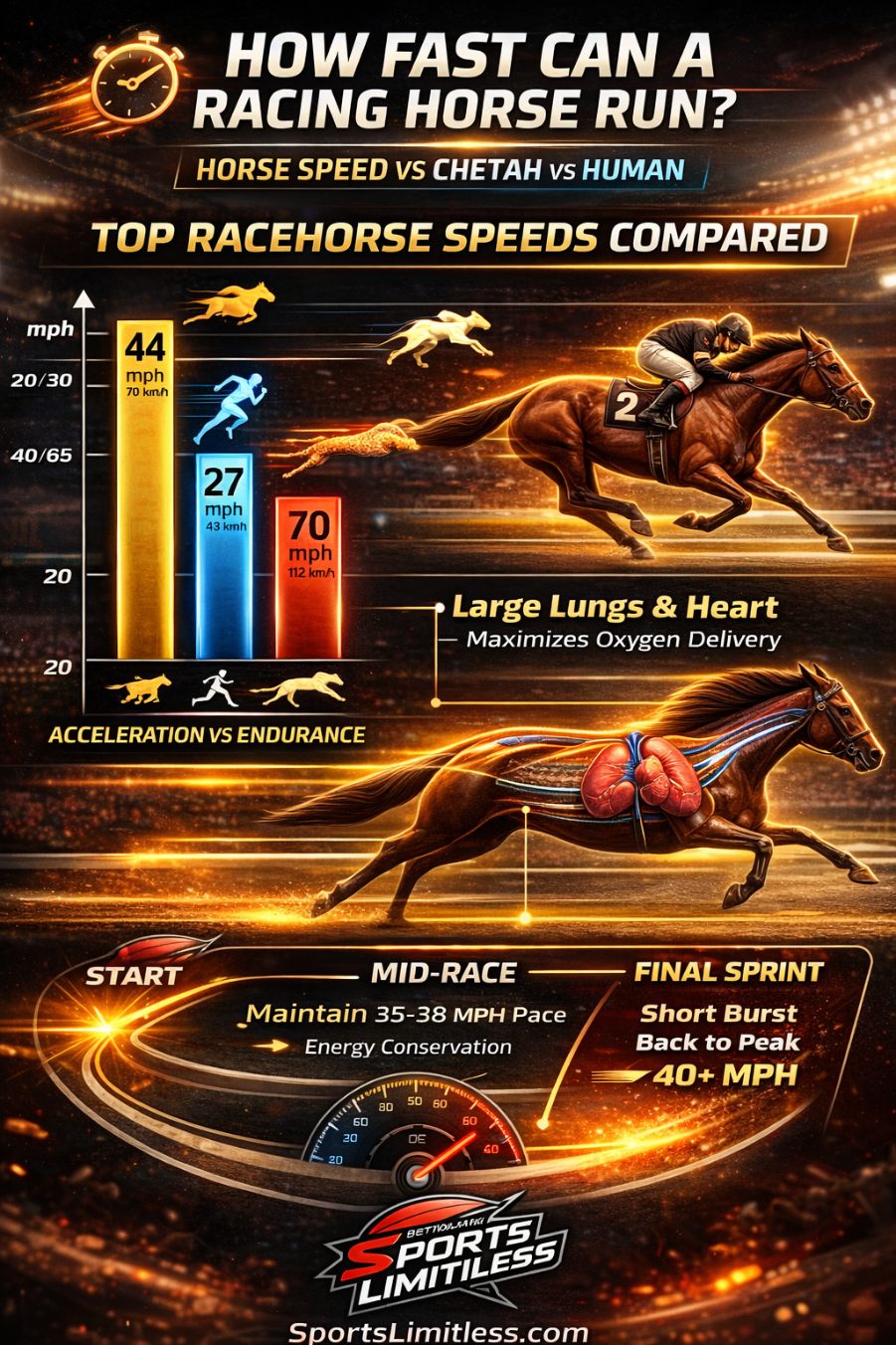
On average, a professional racehorse can hit speeds between 55–70 km/h (34–43 mph) during a race. But under the right conditions, some horses have gone even faster, reaching speeds that rival sprinting cars in short bursts.
In this guide, we’ll break it all down in simple terms. You’ll learn:
– The top recorded speeds of racehorses
– What affects their performance
– Differences between race types
– Real-world examples from famous horses
– And how they compare to humans and other animals
Whether you’re a casual fan or deep into horse racing, this will give you a clear picture of just how fast these animals really are—and why.
How Fast Can a Racing Horse Run on Average?
A typical Thoroughbred racehorse runs at speeds of:
– 55–60 km/h (34–37 mph) during most races
-Up to 65–70 km/h (40–43 mph) in short bursts
That’s fast enough to:
– Outrun the fastest human sprinters
– Keep pace with a car in city traffic
– Cover 1 kilometer in under a minute
Real Example
One of the fastest recorded speeds in racing history came from a horse named Winning Brew, clocked at around 70.8 km/h (43.97 mph). That’s close to the upper limit of what a horse can physically achieve.
Why This Matters
Speed in horse racing isn’t just about peak velocity. It’s about:
– Maintaining high speed over distance
– Accelerating quickly out of the gate
– Timing the final push perfectly
Insight: Most races are won not by the fastest horse overall, but by the one that can sustain near-top speed the longest.
What Makes a Racehorse So Fast?
Racehorses are built differently from regular horses. Everything about them is designed for speed.
Key Physical Traits
– Long, powerful legs → cover more ground per stride
– Flexible spine → allows extended stride length
– Large lungs & heart → better oxygen delivery
– Lean muscle mass → explosive acceleration
Stride Mechanics
A racing horse can:
– Take 6–8 meter strides
– Hit 130–140 strides per minute
That combination is what creates elite speed.
Genetic Advantage
Most racing horses come from carefully bred bloodlines. Breeders select for:
– Speed
– Endurance
– Recovery rate
Unique insight: The cardiovascular system is often more important than muscle. Horses with larger hearts can maintain speed longer, which is why endurance wins races—not just raw power.
Speed Differences by Race Type
Not all horse races are the same. Speed varies depending on distance and style.
Sprint Races (1000–1400m)
– Highest speeds: 65–70 km/h
– Focus: explosive acceleration
– Duration: short and intense
Middle-Distance Races (1400–2000m)
– Speed: 55–60 km/h
– Balance of speed and stamina
Long-Distance Races (2000m+)
-Speed: 50–55 km/h
– Focus: endurance and pacing
Example: In longer races, horses start slower and gradually build speed—saving energy for the final stretch.
Record-Breaking Racehorse Speeds
Here are some notable speed records:
– Winning Brew ~70.8 km/h (Fastest recorded sprint)
– Secretariat ~61 km/h avg (Legendary endurance)
– American Pharoah ~60 km/h (Triple Crown winner)
Secretariat’s Unique Case
While not the fastest in peak speed, Secretariat is famous for:
– Sustaining high speed over long distances
– Increasing speed during the final stretch
Insight: In racing, average speed over distance matters more than peak speed.
How Do Racehorses Compare to Other Animals?
Let’s put horse speed into perspective:
– Cheetah – Top speed 100–120 km/h
– Racehorse – Top speed 55–70 km/h
– Greyhound – Top speed 70 km/h
– Human (Usain Bolt) – Top speed 44.7 km/h
What This Means
– Horses are faster than humans over longer distances
– They can maintain speed much longer than sprinters
– They’re not the fastest animal—but they’re among the most balanced in speed + endurance
Unique insight: Horses are one of the few animals that can sustain high speed for minutes, not just seconds.
Factors That Affect Horse Speed
Even the fastest horse won’t always hit top speed. Several factors come into play:
1. Track Surface
– Dirt → faster acceleration
– Turf → better for endurance
2. Weather Conditions
– Rain → slower times
– Wind → affects stride efficiency
3. Jockey Skill
– Timing the sprint matters
– Positioning in the race is crucial
4. Horse Fitness
– Training intensity
– Recovery cycles
– Nutrition
Insight: A skilled jockey can make a 2–3 second difference, which is massive in racing.
How Horses Maintain Speed During a Race
Maintaining speed is where races are won.
Energy Strategy
Horses don’t sprint full speed the entire race. Instead, they:
– Start controlled
– Build momentum
– Save energy for the final push
Oxygen Efficiency
Racehorses:
– Take one breath per stride
-Maximize oxygen intake
This allows them to sustain speed longer than most animals.
Unique insight: The synchronization of breathing and stride is one of the biggest advantages racehorses have.
Conclusion
So, how fast can a racing horse run? In short: faster than most people expect, and smarter than most realize.
While peak speeds can hit around 70 km/h, what really sets racehorses apart is their ability to sustain high speed over distance. That’s what wins races—not just raw speed.
What makes it even more interesting is how many variables are involved. From breeding and training to track conditions and race strategy, speed isn’t just a number—it’s a system.
If you watch your next race with this in mind, you’ll start noticing things others miss:
– When a horse holds back
– When it accelerates
– How timing beats pure speed
And that’s where horse racing becomes more than just a race—it becomes a strategy game at 60 km/h.
What is the fastest speed ever recorded for a racehorse?
The fastest recorded speed is about 70.8 km/h (43.97 mph), achieved by Winning Brew.
How fast can a racing horse run in mph?
Most racehorses run between 34–43 mph depending on race type.
Are horses faster than humans?
Yes. Even the fastest human sprinter is slower than a racehorse over any meaningful distance.
Do all horses run at the same speed?
No. Breed, training, and genetics all affect how fast a horse can run.
What affects racehorse speed the most?
Key factors include:
– Training
– Track conditions
– Jockey decisions
– Race distance
Did any of these speeds surprise you?
Or maybe you’ve seen a race where a horse just took off in the final stretch?
Drop your thoughts—and if you found this useful, share it with someone who loves horse racing.