
NBA Playoff Bracket Format Explained
The NBA postseason bracket can feel confusing — especially with the Play-In Tournament adding another layer before the traditional playoffs begin. If you’ve wondered how teams qualify, how the bracket is structured, and what the seeding means for matchups and home court, you’re in the right place. This guide breaks down the NBA playoff bracket format step by step in straightforward language. You’ll learn how the Play-In Tournament works, how teams are seeded, how series matchups are determined, how home-court advantage is assigned, and how the bracket flows all the way to the NBA Finals.
Whether you’re here to make smarter bracket predictions, better understand playoff strategy, or simply follow the postseason with more clarity, this guide has you covered — including examples from recent NBA seasons and unique insights into how the bracket format shapes competition.
Overview of the NBA Playoff Structure
The NBA postseason is the culmination of the regular season, where the best teams compete for the Larry O’Brien Championship Trophy. Officially, the NBA postseason consists of two parts:
The Play-In Tournament, which determines the final playoff seeds.
The traditional playoff bracket, where 16 teams compete in a knockout format.
What Is the Playoff Bracket?
The playoff bracket is a single-elimination championship tree with fixed matchups once seeding is set. It shows which teams play each other in each round, and how winners advance toward the NBA Finals. Unlike some sports that reseed teams after each round, the NBA bracket is fixed once the playoffs begin.
How Many Teams Make It?
A total of 16 teams qualify for the NBA playoffs: eight from the Eastern Conference and eight from the Western Conference.
– The top six teams in each conference (by regular-season record) qualify directly.
– Four additional teams (7th through 10th place) enter the Play-In Tournament to compete for the 7th and 8th seeds.
This means as many as 20 teams remain in contention at the end of the regular season, keeping the race exciting late into April.
Conferences and Bracket Division
The playoffs are divided into two separate conference brackets:
– Eastern Conference Bracket
– Western Conference Bracket
The winners of each conference’s finals then face off in the NBA Finals.
From Regular Season to Playoffs: How Teams Qualify
Understanding how teams transition from the regular season into the postseason is key to following the bracket.
Regular Season Standings and Seeding
Teams are ranked in their conference based on regular-season winning percentage. The seeding — which determines matchups in the bracket — is also based on this ranking.
If teams have the same record, the NBA applies established tie-breaker criteria, including head-to-head records, division records, conference records, and point differential.
Play-In Tournament Qualification
Teams finishing 7th to 10th in the regular-season standings in each conference enter the Play-In Tournament.
This mini-tournament decides the final two playoff seeds — 7th and 8th — in each conference bracket.
Tie-Breakers and Seed Order
Here’s how seeding is clarified when teams finish with identical records:
– Head-to-head record
– Division record (if same division)
– Conference record
– Record vs. playoff teams in own conference
– Record vs. playoff teams in opposing conference
– Point differential
These criteria help ensure seeding is fair and reflects season performance.
Understanding the Play-In Tournament
The Play-In Tournament has become a key part of the NBA playoff bracket format.
Format and Matchups
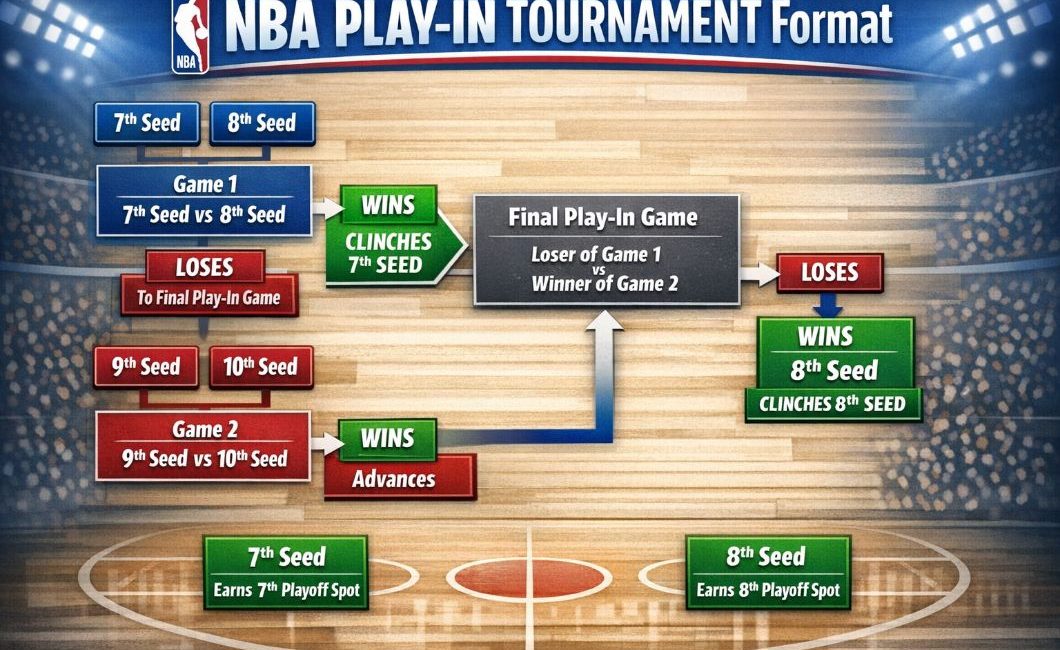
The Play-In Tournament features six teams per conference:
– 7th vs. 8th — winner earns the 7th playoff seed.
– 9th vs. 10th — winner advances to face the loser of 7 vs. 8.
– Final Play-In Game — loser of 7-8 vs. winner of 9-10; winner gets 8th seed.
This structure gives the 7th and 8th teams a “double chance” at qualifying: they need just one win to secure a playoff berth, while 9th and 10th teams must win two games to advance.
How Winners Fill the Bracket
Once the Play-In concludes, each conference will have eight teams — fully seeded 1 through 8 — ready for the traditional playoff bracket.
Competitive Impact of the Play-In
The Play-In adds drama and keeps more teams engaged deep into the season. In recent years, teams seeded as low as 10th have even reached the main playoffs — like the Miami Heat in 2025 becoming the first 10th-seeded team to make the official playoff bracket.
The Traditional NBA Playoff Bracket
Once the seedings are set, the traditional bracket begins.
First Round Matchups
In each conference, the first round is set like this:
– 1st seed vs. 8th seed
– 2nd seed vs. 7th seed
– 3rd seed vs. 6th seed
– 4th seed vs. 5th seed
This standardized bracket ensures balance and clear progression through the postseason.
Comparing Seeds: 1 vs 8, 2 vs 7, etc.
Higher seeds are generally rewarded for stronger regular-season performance:
– The No. 1 seed faces the weakest qualified opponent (8th).
– The No. 2 seed gets a slightly more balanced matchup (7th), and so on.
This rewards success across the 82-game regular season with both home court and more manageable early matchups.
Why There Is No Reseeding
After the first round, the bracket is fixed — meaning winners follow the bracket path and do not get reshuffled based on seeding. Some leagues reseed to reward higher seeds after upsets, but the NBA doesn’t.
Best-of-Seven Series Explained
Every NBA playoff series uses a best-of-seven structure.
How Best-of-Seven Works
In a best-of-seven series, two teams play up to seven games, and the first team to win four games advances.
This longer series — compared to shorter formats in some other sports — tends to reward depth and consistency over time.
Home-Court Advantage and 2-2-1-1-1 Format
The NBA uses a 2-2-1-1-1 home-court format, meaning:
– Higher seed hosts Games 1 & 2, and Games 5 & 7 (if needed)
– Lower seed hosts Games 3 & 4, and Game 6 (if needed)
This setup balances travel and gives the higher seed more home games in crucial late moments.
Advantages for Higher Seeds
Higher seeds benefit from:
– More home games, especially late in brackets
– Favorable early matchups
– Psychological edge in must-win games
These advantages are key reasons teams fight for every regular-season win.
Round-by-Round Breakdown
Let’s walk through each round in the playoff bracket.
First Round
– Held between seeds 1–8 in each conference.
– Winners advance to conference semifinals.
– Upsets can happen but higher seeds generally prevail.
This round is where a strong seed can build momentum or a lower seed can shock the bracket.
Conference Semifinals
– Four teams per conference remain.
– Matchups are bracket-based.
– Teams typically tighten defense and rotations.
This round often reveals the teams that will contest for conference titles.
Conference Finals
– Final two teams in each conference fight for the championship slot.
– Winning earns a trip to the NBA Finals.
NBA Finals
– Eastern Conference champion vs. Western Conference champion.
– Best-of-seven decides the league champion.
This is the ultimate goal of the entire playoff bracket.
Playoff Bracket Examples & Case Studies
Let’s anchor this with recent real playoff scenarios.
Recent Playoff Bracket Breakdown
In the 2024–25 season, the NBA playoffs began after the Play-In Tournament in mid-April and ran into June.
For each round, the traditional format held:
– 1 vs 8
– 2 vs 7
– 3 vs 6
– 4 vs 5 — in both conferences.
Notable Upsets and Cinderella Runs
Although the structure favors higher seeds, upsets still occur — especially in recent years with the Play-In allowing teams like a 10th seed to reach the playoffs.
These stories fuel bracket intrigue and are one reason fans fill out brackets early.
Prediction Strategies
Understanding seeding, matchup history, and how the Play-In shapes the bracket can improve prediction success. Consider:
– How home-court advantage affects outcomes.
– Historical performance of lower seeds.
– Matchups driven by style and strategy.
Common Misconceptions About the Bracket
“Reseeding Happens”
In reality, the NBA does not reseed after rounds — the bracket is fixed once set.
“All 16 Teams Start Equally”
Seeds matter: higher seeds have stronger records, home-court advantage, and often better odds.
“Home Court Doesn’t Matter”
Home court matters a lot — especially in tight series where Games 5 and 7 can decide advancement.
Tips for Filling Out and Predicting Brackets
Stats That Matter
Consider:
– Regular-season record vs. opponents
– Head-to-head matchups
– Recent performance trends
Upset Metrics and Trends
Low seeds winning series is rare, but recent play-in success shows they can overcome the odds.
Fan Strategy
Balance facts and gut instinct — and never discount the momentum a team carries out of the Play-In.
The Future of the NBA Playoff Format
Could the Format Change?
The NBA occasionally reviews its format, but the current system — including Play-In and best-of-seven series — is well-established.
Expansion and Play-In Modifications
Some fans propose tweaks like reseeding, more byes for top teams, or changes to the Play-In eligibility — but nothing is set in stone.
Fan Ideas and League Discussions
Fan forums and analysts often debate “fairness” versus “entertainment” when it comes to bracket structure — and that dialogue keeps evolving.
Frequently Asked Questions
How do teams get seeded in the NBA playoffs?
Teams are seeded based on regular-season winning percentage, with tiebreakers applied when necessary.
What’s the Play-In Tournament format?
The Play-In features seeds 7–10, with a double chance for 7th/8th to secure playoff spots and elimination games for 9th/10th.
Does the NBA reseed after each playoff round?
No — once the bracket is set, teams follow the fixed path until the Finals.
What does 2-2-1-1-1 mean in a playoff series?
This describes how home games are allocated in best-of-seven series: first two and potential Games 5 & 7 go to the higher seed.
Are Play-In games part of the official playoffs?
The NBA considers Play-In separate, though it determines final playoff bracket seeds.
Conclusion
The NBA playoff bracket format is designed to balance competitive integrity, fan excitement, and postseason drama. From the regular season to the Play-In Tournament and through deep best-of-seven series, each step has real implications for teams and fans alike. Understanding how seeding and the bracket structure works adds depth to how you watch and predict the postseason — and gives you a clearer picture of what it takes for teams to chase the Larry O’Brien Trophy.
If you’re filling out your bracket this year or just trying to follow the post-season storylines more closely, knowing the playoff format inside and out will make every matchup more meaningful. Who are you picking to make a deep run this spring?

Sickest Dunks of All Time (NBA’s Craziest Posters)
From MJ to Ja Morant, discover the sickest dunks of all time that shocked fans and broke the internet.
Funny March Madness Bracket Names (Best Ideas for 2026)
Stuck choosing a bracket name? This guide to funny March Madness bracket names includes 100+ clever puns, pop-culture ideas, and office-pool favorites.

Anthony Edwards Net Worth: How Rich Is Ant-Man in 2026?
Anthony Edwards net worth revealed. See his $244M contract, Adidas deal, and how the Timberwolves star built his fortune so early.

Biggest NBA Stadium: The Largest NBA Arenas Ranked
Which NBA arena holds the most fans? See the full ranking of the biggest NBA stadiums and learn what makes these venues legendary for basketball crowds.

Wealthiest Owners in Sports: Billionaires Behind Teams
Meet the wealthiest owners in sports, from NBA tech billionaires to NFL retail dynasties. See who tops the list and how much they’re worth.

Tallest Active NBA Player: The Giants of the Modern NBA
Who is the tallest active NBA player in 2026? Meet the 7-foot giants dominating the league and see how Victor Wembanyama compares with the tallest players ever.

Best Shooting Guards of All Time – Top NBA SG Legends
Who’s really No. 1 on the list of best shooting guards of all time? Jordan? Kobe? Harden? See the full ranking and decide for yourself.

Basketball Positions Explained: NBA Roles & What They Do
Confused about NBA roles? This visual guide breaks down all 5 basketball positions with court maps and real examples.

Most Turnovers in NBA History: Career, Season & Playoff Records
Who really owns the most turnovers in NBA history? The answer might surprise you. Career, season & playoff records revealed.

How Does the Finals Work for NBA? (Full Guide)
How does the Finals work for NBA? From play-in chaos to Game 7 drama, here’s the full postseason breakdown every fan should know.

Highest Vertical Jump NBA: Top Leapers & How They Trained
Who really has the highest vertical jump NBA history has seen? The official 48″ record might surprise you. See the full breakdown.

What Is the NBA Championship Trophy Name? Full Story of the Larry O’Brien Trophy
The NBA championship trophy name explained. From the Walter A. Brown Trophy to Larry O’Brien—full history, facts, and fun trivia.

Nikola Jokic vs Luka Doncic Stats: Who Is the Real Joker?
Jokic or Luka? We compare Nikola Jokic vs Luka Doncic stats, advanced metrics, head-to-head games, and playoff impact to settle the debate.

Youngest NBA MVP: Who Holds the Record?
Flash, finesse, and history made—meet the youngest NBA MVP to ever own the hardwood!

Lowest Scoring NBA Game in History
Buckets were rare! Discover the lowest scoring NBA game ever and why offense took a night off.
NBA Rules on Traveling: What is Traveling in Basketball
Dribble or get whistled! Find out what traveling in basketball means and how the NBA enforces the rules.

MJ’s Rookie Baseball Cards: Most Valuable Michael Jordan Baseball Cards
MJ trading cards aren’t just about basketball—find out which baseball cards are breaking records!

Shortest Basketball Players in the NBA Ever
Height isn’t everything! Meet the shortest NBA players who proved skill always wins.
The Best NBA Power Forwards of All Time
Who’s the GOAT of power forwards? Check out our list of the best NBA big men in history!