
How Long Do NFL Games Last? Average Length of an Football Game
Did you know the Super Bowl gets more than 100 million viewers every year? The grand finale of the NFL is a true spectacle that everyone enjoys, but not too many teams and players get to experience it. Only the best two teams of the season will compete for the World Champion title.
To get there, teams must clash over 17 weeks, totaling 200 different games played by 32 squads. Each game is a story on its own, but they all last more or less a similar amount of time. Although rarely the same up to a second, they usually last around three hours.
So why do they last so long when the actual time of every game is set to 60 minutes? What makes the games spread to around three times more than the official timeplay? Let’s dive into this and see why NFL games last so much longer.
How Long Are NFL Games?
If you look at the rules of the game, every professional American football match lasts exactly one hour. This one hour is divided into four quarters lasting 15 minutes each. When the clock runs out, the game ends or goes into overtime. This, again, prolongs the time and if there must be a winner, but no team scores points, the match may last indefinitely, at least in theory.
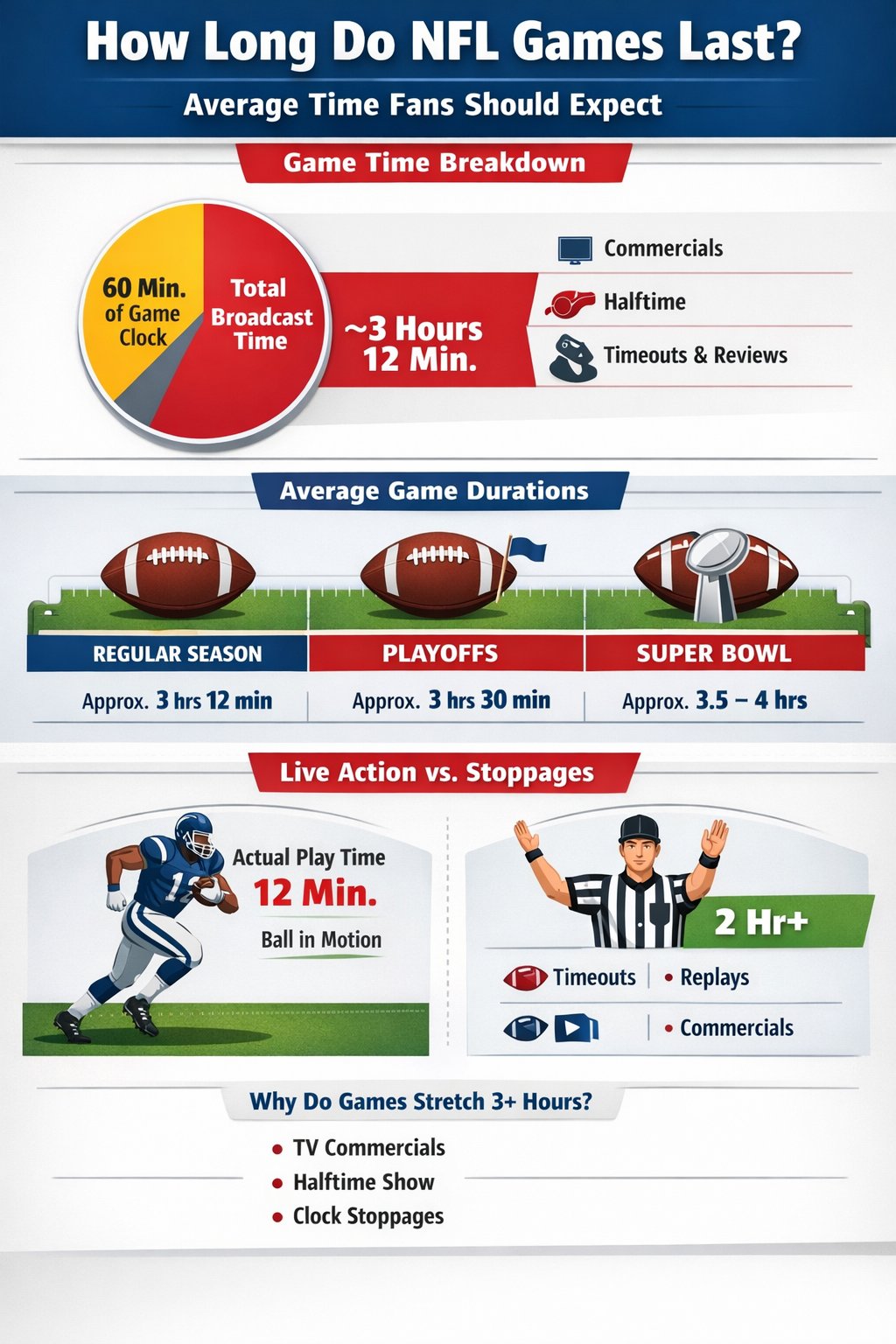
So, answering this question is technically impossible, but, most cases tell us that an NFL game will last around three hours with everything included. If you want to call your friends and watch a game, but have plans to go somewhere else after that, be aware that this will take at least three hours.
How long is a college football game?
Although NFL and college games have some differences, when it comes to the duration, they are exactly the same. College football games also last one hour divided into four 15-minute quarters, with the entire length lasting around three hours.
The only difference when it comes to game duration is the slightly extended stoppage time between plays because of the nature of the players. The NFL, standing for National Football Association, is a league for professional players, and the College Football League consists of amateur players who represent their college, meaning the latter are not as prepared for the mental and physical challenges that football brings. However, if there’s no overtime, matches still last around three hours, just as they do in the NFL.
How long do NFL games last on TV?
We can easily say that NFL games are a great experience to attend, but the TV broadcast is also something to enjoy. Many prefer watching sports on a huge TV set in dedicated personal theater rooms than going to the stadiums. The reason is simple – these broadcasts have a lot to offer.
Viewers will spend three hours in front of the TV, but the director of the broadcast, the cameramen, and everyone else involved in the process will be there much longer to provide the perfect experience for the viewers.
What is the longest NFL game aired on TV?
When you’re thinking about how long do NFL football games last, it’s easy to say about three hours, more or less, but going with that presumption means you can be badly mistaken. If someone was planning their day according to the NFL game played in Miami between the Dolphins and the Tennessee Titans on September 9th, 2018, they made a huge mistake. The match lasted seven hours and eight minutes in total due to bad weather.
It’s interesting that the longest official playing time in a match is also connected to the Miami Dolphins. They played the Kansas City Chiefs on Christmas Day in 1971. Their total playing time was a whopping 82 minutes and 40 seconds. However, the entire event lasted an almost standard three hours and 21 minutes.
In other words, even the longest official games in NFL history are not even close to the other when it comes to logical time length. You’d assume that the longest official stoppage time would result in a match that also lasted the longest, but that’s not the case here.
What Makes NFL Games So Long?
Commercial Breaks
TV ads are the biggest reason games run long. A typical NFL broadcast includes:
- Around 20 commercial breaks
- Roughly 60 minutes of total advertising time
This is a major reason why NFL games take longer than most fans expect.
Timeouts and the Two-Minute Warning
Each team gets:
- Three timeouts per half
- An automatic two-minute warning at the end of each half
These stoppages are strategic but also slow the pace, especially late in close games.
Replay Reviews
Instant replay has improved accuracy, but it costs time. Reviews can take:
- 1–3 minutes each
- Longer in critical moments
Late-game reviews feel especially slow because every second matters.
Penalties and Injuries
Penalties stop the clock and reset plays. Injuries add even more delay, especially when medical staff need extra time on the field.
Clock Time vs Actual Football Action
How Much Football Is Really Played?
Here’s the surprising part: the ball is only in active play for about:
- 11 to 18 minutes per game
That means the majority of a three-hour broadcast is made up of:
- Pre-snap adjustments
- Replays
- Commercials
- Players getting set
This stat alone explains why NFL games feel long even when they’re exciting.
Why Fans Still Watch Every Minute
Despite the stop-start nature, every snap matters. One play can change the outcome, which is why fans stay locked in even when the clock isn’t moving.
Overtime and Game Length
Regular Season Overtime
If a game is tied after regulation:
- A 10-minute overtime period is played
- If no one scores, the game ends in a tie
Not every overtime uses the full 10 minutes, but close games can stretch well past the three-hour mark.
Playoff Overtime
Playoff overtime has no time limit. Teams keep playing until a winner is decided. These games can become some of the longest in NFL history.
Halftime: How Long Is the Break?
Regular Season Halftime
A normal NFL halftime lasts:
- 12 minutes
That’s just enough time for locker room adjustments and a quick TV analysis.
Super Bowl Halftime
The Super Bowl halftime show runs:
- 30 minutes or more
This alone adds nearly 20 extra minutes compared to a regular-season game.
NFL Games Compared to Other Sports
NFL vs NBA
- NBA games: ~2 hours 15 minutes
- NFL games: ~3 hours 12 minutes
NFL vs MLB
- MLB games: ~2 hours 40 minutes
- NFL games still run longer despite fewer total games
Why NFL Feels Slower
Football’s structure — short bursts of action with heavy strategy — naturally leads to more stoppages than continuous sports like soccer or hockey.
How Fans Can Plan Around NFL Game Length
If you’re heading to a watch party or hosting friends:
- Block off at least 3.5 hours
- Expect close games to run longer
- Prime-time games often push late
If you’re short on time, condensed replays and highlights can give you the core action in under 45 minutes.
Conclusion
When we summarise everything, we come to a clear conclusion – the average length of an NFL game is around three hours even though the official playing time is 60 minutes. If you’re preparing your marketing plans, writing an essay for school, or learning about the sport, these are the numbers you should have in mind.
If you’re thinking about having a game with your friends and want to know how much other leagues play, it is still the same number. The length of other minor leagues is also set to 60 minutes, so no matter the level of professionalism you and your friends have, you should always aim for the same numbers.
FAQs
How long do NFL games last including commercials?
Most games last around 3 hours and 12 minutes including all breaks.
Why are NFL games longer than college football games?
NFL broadcasts include more commercial breaks and longer reviews.
How long is an NFL halftime?
Regular season halftime is 12 minutes. The Super Bowl halftime is much longer.
How long can overtime make an NFL game?
Overtime can add up to 10+ minutes in real time, especially in playoffs.
What’s the shortest possible NFL game length?
A fast game with few stoppages can finish in just under 3 hours, but it’s rare.
Join the Conversation
How long do you feel NFL games last when your team is playing?
Do close games feel longer than blowouts? Share your thoughts — and send this article to the friend who always asks, “Is this game almost over?”